





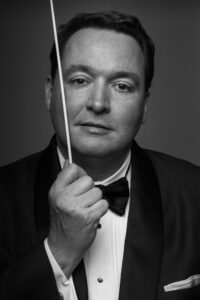
 Erik Ochsner, Music Director
Finnish-American conductor Erik Ochesner is honored and thrilled to be the new Artistic Director and Music Director of the Youngstown Symphony Orchestra. he first appeared with the orchestra to conduct performances of Ghostbusters Live in Concert in 2022; subsequently he has been invited back as a guest conductor seven times culminating in his hiring.
Ochsner’s versatility as a conductor has stretched across a broad range of repertoire: from conducting as few as five performers in contemporary and modern works, to leading 300 performers across 20+ full length films using the Live in Concert format. Audiences and critics alike praise Ochsner’s energy, attention to detail, and precise synchronization.
Highlights of his appearances in Youngstown: Mahler Symphony No. 1, Strauss’ Overture to Die Fledermaus, Mozart Piano Concerto No. 23, a specially curated concert including 7 works called Unknown and Gorgeous: River and Iron, which featured the US premieres of Uuno Klami’s Kalevala Suite, and Eugene Kapp’s Kalevipoeg Ballet Suite (1947), plus Respighi’s Pines of Rome; two more film concerts, Home Alone in Concert, and Back to the Future in Concert: a concert featuring The Vindys and the YSO, a narrated Superheroes concert, a Romeo and Juliet concert with soprano Avery Boettcher, and a concert with Beethoven’s Symphony No. 3 and 2 pieces of Luigi Cherubini.
Most recently, Ochsner conducted three performances of Lion King (1994) Live in Concert, and three performances of Frozen Live in Concert with the Armenian State Symphony Orchestra in Dammam, Saudi Arabia. Upcoming performances include performances of Star Wars in Concert: Episode 6: Return of the Jedi and Nightmare Before Christmas with the Filmharmonique orchestra in Edmonton, Canada, and Lion King (1994) Live in Concert in Oman.
Working with his friend Dr. Ruth Westheimer, Ochsner commissioned Tom Chapin and John Forster to create a new piece for three actors and chamber orchestra: Grandfather Camp: An Orchestral Fantasy. The story is based on Dr. Ruth’s writings about grandparenting. A successful development workshop took place, and the piece is currently being orchestrated for future performance!
Ochsner’s long relationship with the Krakow International Film Music Festival have been hugely successful leading sold out performances in a 16,000 seat arena of Pixar in Concert, Frozen, Beauty and the Beast, and Lion King (1994) (all performed in Polish), plus Disney in Concert: The Magic of Music with the Krakow Film Festival Youth Orchestra.
As Principal Touring Conductor for La La Land Live in Concert, Ochsner conducted 50 performances across the globe of Justin Hurwitz’s Academy Award and Grammy Award winning score, often performing with two of the original recording artists, pianist Randy Kerber, and trumpeter Wayne Bergeron.
Ochsner conducted the world premiere of Mary Poppins (1964) with the Sydney Symphony Orchestra at the Symphony Opera House; made his debut with the San Francisco Symphony Orchestra conducting Love Actually; on 40 hours’ notice, he flew to Taipei to conduct Beauty and the Beast in Concert to fill in for an ailing colleague; at the Nanjing Forest Music Festival in China, he conducted a concert of 18 suites of Hollywood film music; Music Director of the 2017 Opera America New Works Showcase in New York City. In collaboration with the National Arts Centre Orchestra in Ottowa, Ochsner led the premiere of The Music of Star Wars featuring the iconic music of John Williams, as well as award-winning video game composers Gordy Haab and Kyle Newmaster.
Other Film projects he has conducted include: Back to the Future, Beauty and the Beast (2017), Batman (1989), bugs Bunny at the Symphony, E.T. the Extra-Terrestrial, Frozen, Ghostbusters, Home Alone, La La Land, Lord of the Rings: Fellowship of the Ring, Love Actually, Pirates of the Caribbean, Pixar in Concert, Star Trek (2009), Star Trek Into Darkness, Star Wars in Concert: Episodes 4, 5, and 6.
Equally comforable on the concert stage or leading opera, oratorio, and mutli-media performances, he has performed in Adelaide, Athens, Beijing, Budapest, Calgary, Dallas, Dammam, Detroit, Indianapolis, Jakarta, Kitchener-Waterloo, Krakow, Leipzig, Louisiana, Louisville, Melbourne, México City, Montreal, Monterrey, Moscow, Nashville, New York, Ottowa, Portland, Reykjavik, Richmond, Rochester, Round Top, San Antonio, San Diego, San Francisco, Seattle, Seoul, Shanghai, Sofia, South Bend, St. Louis, St. Petersberg, Stockholm, Sydney, Taipei, Tampere, Tokyo, Vancouver, Wellington, and Youngstown.
He is Founder and Music Director of SONOS Chamber Orchestra which performed Rite of Spring in an arrangement for 4 pianos and 2 percussionists. The New York Times said, “All the hallmarks of a great “Rite” were here.”
During an 8-year collaboration, Ochsner served as Rehearsal Conductor for Academy Award winning composer Tan Dun (Crouching Tiger, Hidden Dragon). Highlights include Assistant Conductor and Chorus Master for The First Emperor workshop, a Metropolitan Opera commission, and Cover conductor with the Boston Symphony Orchestra for the world premiere of The Map, a multimedia cello featuring Yo-Yo Ma, with performances in Boston, Carnegie Hall, and Tanglewood.
The Bulgarian Monitor said, “Sensuality and synchronicity, matched by perfection, accompanied each of the melodies during La La Land: Live in Concert.” Radio Canada wrote, “[Ochsner} was of remarkable precision to the musical direction…the music of the orchestra seemed to emanate from the film. There was no distinction between the screen and the stage.” The Ontario Arts Review has said “Watch this man, he is brilliant.”
Recordings include Brian Wilbur Grundstrom: An Orchestral Journey (CD), and Tea: A Mirror of Soul (DVD).
Ochsner attended The Pierre Monteux School and is a graduate of Dartmouth College. He speaks French, German, and Italian. His mentors and teachers include Robert Spano, Charles Bruck, Erich Kunzel, Marin Alsop, and Helmuth Riling. He lives in New York City, loves traveling, wine, and collecting requiem recordings.
Richard Wagner (arr. L. Šťastný) Siegfried’s Death and Funeral March (from Götterdämmerung)
(1813-1883)
Jean Sibelius Night Ride and Sunrise
(1865-1957)
John Williams Olympic Fanfare
(b. 1932)
John Williams Adventures on Earth (from E.T.: The Extra-Terrestrial)
(b. 1932)
-INTERMISSION-
Hector Berlioz Symphonie fantastique
(1803-1869) i. Rêveries – Passions (Reveries – Passions)
ii. Un bal (A Ball)
iii. Scène aux champs (Scene in the Country)
iv. Marche au supplice (March to the Scaffold)
v. Songe d’une nuit du sabbat (Dream of a Witches’ Sabbath)
For Underwriting Opportunities, click Here.
Program Notes
by Music Director, Erik Ochsner
Today’s program marks my first official classical concert as Music Director of the Youngstown Symphony Orchestra. It was suggested to me to make the two classical concerts in our season somewhat autobiographical. I chose “programmatic” works which all tell a story and are part of my life story.
From the years where I studied and worked at the Bayreuth International Youth Festival, to my mother’s Finnish heritage, to my lifelong encounters and love for the works of John Williams (and my family’s close relationship with conductor Erich Kunzel, former Music Director of the Cincinnati “Pops” Orchestra, who programmed a lot of John Williams), and finally to my direct line connections and lineage from Charles Bruch, my conducting teacher, to his teacher, Pierre Monteux, who studied with one of Berlioz’ friends, Édouard Colonne.
In the first half, we’ll hear a chronological progression through three composers and their programmatic pieces, and then in the second half, we actually go back in time to the earliest composed piece on the program – which proved to be the most groundbreaking and inspirational for ALL composers.
Composer: Richard Wagner (1813-1883)
Götterdämmerung: Siegfried’s Death – Funeral March
Premiere: August 17, 1876, in Bayreuth, Germany
Approximate Duration: 9 minutes.
The piece is scored for: 2 flutes (1 doubling piccolo), 2 oboes, 2 clarinets, 2 bassoons, 4 horns, 2 trumpets, 3 trombones, tuba, timpani, percussion (bass drum, cymbal, triangle), harp, and strings.
This is the first performance of this piece by the Youngstown Symphony Orchestra.
Richard Wagner was a revolutionary German composer and conductor who redefined opera thorugh his concept of Gesamtkunstwerk (“total work of art”). By uniting music,
drama, and visual arts, his works – including Tristan und Isolde and The Ring Cycle – pioneered the use of elaborate leitmotifs and rich chromaticism. His innovations fundamentally shifted the course of Western music, leading to the construction of the Bayreuth Festspielhaus to house his monumental music dramas.
Richard Wagner’s Der Ring des Nibelungen (The Ring of the Nibelungs, aka “The Ring Cycle”) is a four- opera project that took him over 25 years to complete. The epic is based on Norse/Germanic myths. Siegfried is the cycle’s tragic hero. With his father’s sword, he has slain the dragon Fafner, recovered a cursed ring forged from gold stolen from the Rhine by the evil Nibelung Alberich, and rescued Brünnhilde, who is one of the Valkyries and a daughter of Wotan. In Götterdämmerung (Twilight of the Gods), Siegfried ignores a warning to give up the ring and dies at the hand of Alberich’s illegitimate son Hagen, who literally stabs the hero in the back. The narrative explores themes of power, love, greed, and fate, driven by the ring’s curse: whoever possesses it fears losing it, and is ultimately killed by the next owner.
Wagner composed his opera Götterdämmerung between 1869 and 1874. It is the last of the four Ring Cycle operas. The opera is much renowned for its orchestral sequences, and these are often performed as concert excerpts. Siegfried’s Funeral March is taken from Act Threee after he has been murdered by Hagen. It is made up of musical motives from previous operas that tell of Siegried’s background, including the Volsung theme, Siegmund and Sieglinde’s theme, the Sword, Brünnhilde’s love theme and the curse of the Ring. A concert ending was added to bring the excerpt to a close.
Composer: Jeane Sibelius (1865-1957)
Öinen ratsastus ja auringonnousu, Opus 55 (Night Ride and Sunrise)
Premiere: January 23, 1909, in Saint Petersburg, Russia
Approximate Duration: 16 minutes
The piece is scored for: 2 flutes, piccolo, 2 oboes, 2 clarinets, 1 bass clarinet, 2 bassoons, 1 contrabassoon, 4 horns, 2 trumpets, 3 trombones, 1 tuba, timpani, percussion (bass drum, snare drum, tambourine, triangle), and strings.
This is the first performance of this piece by the Youngstown Symphony Orchestra.
Jean Sibelius was Finland’s most celebrated composer and a cornerstone of late-Romantic music. Renowned for his seven symphonies and the iconic tone poem, Finlandia, his works are deeply rooted in Finnish mythology and the stark beauty of the Nordic landscape. His innovative symphonic structures and evocative orchestration helped define Finland’s national identity. Sibelius remains one of the 20th century’s most influential symphonists, his music a staple of concert halls worldwide.
Sibelius wrote that this piece is about “the inner experiences of an aerage man riding solitary through the forest gloom; sometimes glad to be alone with Nature; occasionally awe-stricken by the stillness or the strange sounds which break it; but thankful and rejoicing in the daybreak.”
We’ve all been alone many times in our lives, perhaps in the modern world, driving alone. What goes through your mind on these drives?
Sibelius begins the piece with a burst of sound, perhaps as a way of clearing the air(?), or a signal that we’re ready to go (?), or a harsh snap of the whip(?). The first half of the piece contains a galloping or trotting rhythm, representing the nighttime sleigh ride. The persistent trochaic rhythm brings even minimalist tones to the work. This motif varies in volume, intensity, and melodic shape, evoking a sense of the irregular terrain one would experience while riding through the woods. Perhaps the sled slips to the left, and to the right. The second section (the sunrise) begins slowly and happens seamlessly – an exquisite Northern sunrise whose first rays emerge from the horns. This is one of Sibelius’ most overt portrayals fo nature. It grows out of the darker music in the first half of the piece, just as the protagonist would witness in his jaunt through the woods.
Composer: John Williams (b. 1932)
Olympic Fanfare (1984)
Premiere: July 28, 1984, in Los Angeles
Approximate Duration: 5 minutes
The piece is scored for: 2 flutes, piccolo, 2 oboes, 2 clarinets, 2 bassoons, 4 horns, 4 trumpets, 3 trombones, tuba, timpani, percussion (bass drum, snare drum, crash cymbals, chimes, glockenspiel, triangle, and vibraphone), piano, and strings.
This is the first performance of this piece by the Youngstown Symphony Orchestra.
John Williams IS a household name, and that’s pretty rare for a film composer! To be honest, Williams has composed a LOT of non-film music, too, including many television themes, perhaps most famously the theme to Gilligan’s Island, plus 20 concertos for various
instruments. he has been celebrated worldwide, and has guest conducted all of the major symphony orchestras. Sadly, some orchestras only program his non-concerto works on pops programs. As his music has played such an important role in my life as a musician, I wanted to feature him on a classical program. His lush, neo-romantic style and unforgettable leitmotifs have made him a towering figure in contemporary orchestral music.
This piece was written specifically for the opening ceremonies of the 1984 Olympic Games in Los Angeles. Premiered by the 800-member strong Olympic All-American Marching Band, the opening fanfare was performed outdoors at the at the Olympic Stadium with 150 trumpets!
As the composer wrote in 1984: “The Olympic Games continue to fascinate and inspire us. With every presentation of the Games, we experience that complete dedication and unshakable will to perservere that typifies the goal of each competitor. The human spirit soars, and we strive for the best within us.”
Williams also said, “The human spirit soars and we strive for the best within it. These are the qualities which we seek to capture, describe, and preserve through music.”
Composer: John Williams (b. 1932)
Adventures on Earth (from E.T.: The Extra-Terrestrial) (1982)
Premiere: 1982
Approximate Duration: 10 minutes
The piece is scored for: 2 flutes, piccolo, 2 oboes, 2 clarinets, 3 bassoons, contrabassoon, 4 horns, 3 trumpets, 3 trombones, 5uba, timpani, percussion (bass drum, chimes, cymbals, glockenspiel, gong, snare drum, suspended cymbal, triangle, vibraphone, xylophone), harp, piano, celesta, and strings.
This is the first performance of this piece by the Youngstown Symphony Orchestra.
John Williams is the most celebrated film composer of the modern era, known for his iconic scores to Star Wars, Jaws, and Harry Potter. Overa seven-decade career, Williams has won numerous prestigious
awards, including 5 Academy Awards, 26 Grammy Awards, 7 BAFTA Awards, 4 Golden Globes, and 3 Emmy Awards, among many others, with a remarkable 54 Oscar nominations making him the second most-nominated person ever, after Walt Disney, according to Wikipedia.
E.T. the Extra-Terrestrial won four Academy Awards at the 55th Oscars in 1983, including Best Original Score, Best Sound, Best Sound Effects Editing, and Best Visual Effects, though it was famously nominated for nine Oscars, losing Best Picture to Ghandi.
The 1982 film E.T. the Extra-Terrestrial offered another seismic success in the relationship between John Williams and Steven Spielberg, and a decision the latter made during the recording process demonstrates the respect each man had for the contributions of the other. Williams was recording the lengthy and complex music for the finale of the film, and he was having difficulty synching the orchestra’s performance to the many precise cuts and beats of the picture edit. After several takes, Spielberg offered to turn off the film and allow Williams to record the music on its own, with exactly the tempos and phrasing he felt the music required. When it was recorded to Williams’ satisfaction, Spielberg then recut the end of the film to match this musical performance. The result was one of the most iconic sequences in move history, and “Adventures on Earth.” – From the Los Angeles Philharmonic archive.
Composer: Hector Berlioz (1803-1869)
Symphonie fantastique
Premiere: December 5, 1830, in Paris, France
Approximate Duration: 55 minutes
The piece is scored for: 2 flutes (second doubling on piccolo), 2 oboes (second doubling on English horn), 2 clarinets (first doubling on e-flat clarinet), 4 bassoons, 4 horns, 2 trumpets, 2 cornets, 3 trombones, 2 tubas (originally ophicleides), 2 timpani, percussion (bass drum, snare drum, cymbals, bells), 2 harps, and strings.
The last performance of this piece by the Youngstown Symphony Orchestra was in 2005, under the baton of then Music Director, Isaiah Allen Jackson.
Hector Berlioz was a visionary French composer and a primary architect of Romanticism. Famous for his groundbreaking Symphonie fantastique, he pioneered program music and significantly expanded the size and technical capabilities of the modern orchestra.
His “Treatise on Instrumentation” revolutionized orchestral writing for generations. A master of grand, dramatic forms, Berlioz’s daring harmonies and innovative orchestration challenged 19th- century conventions, establishing him as one of history’s most original musical thinkers.
Berlioz first saw the irish actress Harriet Smithson on September 11, 1827, when she played Ophelia in Hamlet with a troupe of English actors visiting Paris. By the time of her departure from Paris in 1829, Berlioz had made himself known to her through letters, but they did not meet. Then on December 9, 1832, in true storybook fashion – and as vividly recounted in his own Memoirs – Hector Berlioz won the heart of his beloved Harriet Smithson, whom he had never met! She attended a concert including the Symphonie fantastique, for which she had unknowingly served as inspiration when the composer fell hopelessly in love with her some years before. The two met the next day and were married on the following October 4, 1932. The unfortunate but true conclusion to this seemingly happy tale is that Belioz and his “Henriette” as he called her, were formally separated in 1844.
David Cairns, whose translation of Berlioz’s Memoirs” is the one to read, has written that “Berlioz in the ‘Fantastic’ symphony was speaking a new language: not only a new language of orchestral sound…but also a new language of feeling… the outward and visible sign of which was the unheard of fastidiousness with which nuances of expression were marked in the score.
The famous dies irae theme heard in the fifth movement is from the Catholic Requiem mass which honors the dead and consloes the living. “Day of wrath and doom impending!”
Berlioz’s Own Program Notes for Symphonie fantastique
Program of the Symphony
A young musician of morbidly sensitive temperament and fiery imagination poisons himself with opium in a fit of lovesick despair. The dose of the narcotic, too weak to kill him, plunges him into a deep slumber accompanied by the strangest visions, during which his sensations, his emotions, his memories are transformed in his sick mind into musical thoughts and images. The loved on herself has become a melody to him, an idée fixe as it were, that he encounters and hears everywhere.
Part I – Reveries, Passions
He recalls first that soul-sickness, that vagues des passions, those depressions, those groundless joys, that he experienced before he first saw his loved one; then the volcanic love that she suddenly inspired in him, his frenzied suffering, his jealous rages, his returns to tenderness, his religious consolations.
Part II – A Ball
He encounters the loved one at a dance in the midst of the tumult of a brilliant party.
Part III – Scene in the Country
One summer evening in the country, he hears two shepherds piping a ranz des vaches [a work song traditionally played on the horn by the Swiss Alpine herdsmen] in dialogue; this pastoral duet, the scenery, the quiet rustling of the trees gently brushed by the wind, the hopes he has recently found some reason to entertain – all concur in affording his heart an unaccustomed calm, and in giving a more cheerful color to his ideas. But she appears again, he feels a tightening in his heart, painful presentiments disturb him – what if she were deceiving him? – One of the shepherds takes up his simple tune again, the other no longer answers. The sun sets – distant sound of thunder – loneliness – silence.
Part IV – March to the Scaffold
He dreams that he has killed his beloved, that he is condemned to death and led to the scaffold. The procession moves forward to the sounds of a march that is now somber and fierce, now brilliant and solemn, in which the muffled sound of heavy steps gives way without transition to the noisiest clamore. At the end, the idée fixe returns for a moment, like a last though of love interrupted by the fatal blow.
Part V – Dream of a Witches’ Sabbath
He sees himself at the sabbath, in the midst of a frightful troop of ghosts, sorcerers, monsters of every kind, come together for his funeral. Strange noises, groans, bursts of laughter, distant cries which other cries seem to answer. The beloved’s melody appears again, but it has lost its character of nobility and shyness; it is no more than a dance tune, mean, trivial, and grotesque: it is she, coming to join the sabbath. – A roar of joy at her arrival. – She takes part in the devilish orgy. – Funeral knell, burlesque parody of the Dies irae, sabbath round-dance. The sabbath round and the Dies irae combined.